
Inboard vs Outboard: How to Choose the Right Propulsion for Your Needs
Inboard vs Outboard: How to Choose the Right Propulsion for Your Needs
At Tiara Yachts, we know that a yacht is never defined by just one feature. It is how each detail comes together that informs the overall experience. The character of the boat is an amalgamation of performance, design, and the feelings that come from being out on the water. Curating that experience is what we know best.
That experience, although carefully crafted, is also uniquely individual. There is one decision that defines the experience from the moment it’s made: propulsion.
Propulsion shapes the experience in a way that no other feature can. It defines the look of the transom, how the boat handles, the confidence you carry into different kinds of water, and so much more.
At Tiara Yachts, the better question is not simply which propulsion is better, but which propulsion is better for the way you want to boat. The key to choosing between inboard vs. outboard is understanding how each one supports the life you want to build on the water.
Start With The Experience You Are Curating
Choosing between inboard and outboard engines can feel daunting. It’s an investment in your experience on the water from that day forward. However, the decision becomes much easier once you start understanding the experience you value on the water.
Outboard engines are impressive, as they add horsepower you can see, hear, and feel. While that might be for you, other owners may choose the quieter, more responsive handling of an inboard engine. Both are compelling. They simply create different experiences.
This is where propulsion becomes personal. The body of water you return to most often matters. The activities you and your guest look forward to most matter. Even the way you want the yacht to look and feel at rest matters. When viewed through that lens, the question is no longer just inboard versus outboard. It becomes a question of how you want the yacht to support your life on the water.
The Distinct Appeal Of Inboard Propulsion
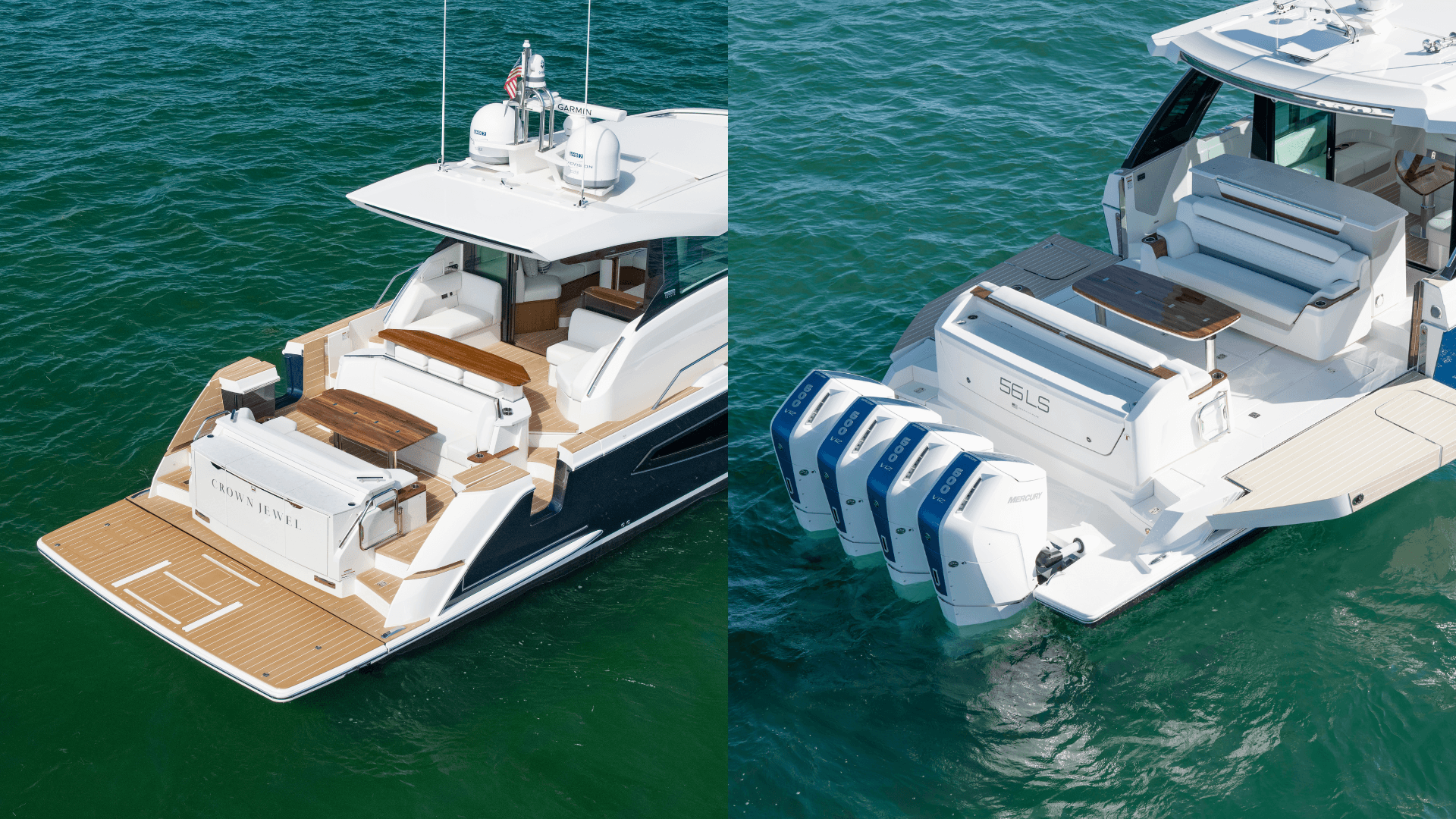
For many owners, the appeal of an inboard engine begins with the silhouette of the yacht itself. Because the propulsion system is positioned within the hull, the result is a cleaner transom and a more streamlined profile. This sleek look and feel is the yachting identity that is deeply connected to the traditional luxury yachting experience.
That refinement isn’t superficial, but can actually be felt once you leave the dock. Inboard propulsion is often appreciated for its central weight distribution that contributes to a smooth, balanced feel underway. For owners who prioritize composed handling and a quieter ride, that can be a meaningful advantage.
That legacy runs deep at Tiara Yachts. Series such as the Open, Flybridge, Coupe, and Sovran helped define what many owners came to recognize as the Tiara Yacht experience.
Today, that tradition continues in Tiara Yacht’s larger offerings, including the EX 54 and EX 60, where twin Volvo Penta integrated propulsion systems bring together efficiency, maneuverability, and the refined performance that has come to be expected over the past fifty-two years.
There are practical benefits as well. Inboard propulsion can create an overall cleaner aft layout, along with the kind of open swim platform and uninterrupted transom space that many owners value. This space is perfect for opening up the connection between boat and water and seamlessly connecting the two for entertaining, relaxing, or a variety of watersports.
Inboard Engine Tradeoffs To Understand From The Start:
- There can be a greater learning curve. For newer boaters, maneuvering and trailering an inboard can take more time to get comfortable with than other propulsion styles.
- Shallow water can require more caution. Because the rudder, propeller, and shaft remain fixed near the deepest part of the hull, inboards are not as naturally suited to shallow-water operation.
- Service access can be tighter. Routine maintenance on an inboard often means working beneath an engine hatch and in more confined spaces than an externally mounted propulsion package.
- The layout asks for a different kind of compromise. While many owners love the cleaner transom and integrated feel, that refinement does come with space allocated inside the yacht for the engine room rather than additional storage or accommodations.
Whereas inboard offers a more integrated, traditional yacht feel, for other owners, those tradeoffs are precisely what make outboard propulsion so appealing.
Where Outboard Comes Into Its Own
Where inboard offers a more traditional yachting experience, outboard introduces a different kind of freedom on the water. Unlike an inboard engine, an outboard engine(s) lives outside the hull, where its presence becomes part of the yacht’s overall character. For some contemporary yacht owners, that visible power center is part of the appeal of outboard engines. It is defined by horsepower you can see, and it signals the capability and performance that outboard engines can provide.
The appeal of outboard engines isn’t just visual. Although strong performance is a defining quality, practicality is also a quality of outboards. Since the engine is mounted externally, service is often much easier to perform. Service can be done without technicians moving through the interior carrying dirty oil or greasy tools, and key service points like fuel filters are positioned where they can be reached more efficiently from the easily accessible mechanical space.
At Tiara Yachts, the outboard story has become an important part of the modern boating enthusiast’s evolution. Outboard-powered models are designed for performance, day yachting, and versatile coastal cruising, primarily using Mercury Marine propulsion packages.
That vision comes to life across the LS, LE, and LX series, each uniquely offering a take on how outboard power can enhance time on the water. The LS series includes models like the 35 LS, 46 LS, and 56 LS, the latter marking Tiara Yacht’s first quad-engine boat with four Mercury V12 600hp outboards. The LE series includes models such as the 39 LE and 48 LE, with the 48 LE designed specifically around triple Mercury V12 600hp outboards. The LX series, including the 34 LX, offers a memorable crossover experience between performance-focused cruising and relaxed day boating.
Outboard engines provide practical advantages to the layout that most boat owners have come to expect. With the engines mounted on the back of the transom, more of the boat can be dedicated to seating and entertaining. Below deck, the possibilities open up, turning what would have been an engine room into valuable storage and more expansive cabin space. Boaters who spend time in shallower water also tend to appreciate the flexibility of an engine that can be trimmed up, helping reduce draft and create more confidence in a wider range of conditions.
Outboard Engine Considerations:
- The engines remain visible at the transom. Outboard engines have a more distinctive look, especially when mounting multiple engines. For some owners, that powerful presence is what boating is all about; for others, it detracts from the elevated yachting experience both in look and sound.
- A shared swim platform experience. Because of the location of the engines, the aft area is shared with the engines rather than being left available for lounging or water access.
- Larger yachts may require multiple outboards. That can create impressive capability and performance, but it also changes the visual character of the stern and makes the propulsion package a more prominent part of the overall design.
- The experience is more outwardly expressive. Where inboard propulsion often feels quieter and more concealed, outboard propulsion makes its presence known. For some, that enhances the adventure. For others, it may feel less aligned with the more understated yachting experience they have in mind.
How You Shape The Answer
Once the distinctions between propulsion styles are clear, the decision becomes much more personal. It becomes a question of alignment. After all, what matters most is what you need once you are on the water.
For some boaters, that answer becomes obvious the moment they think about where they boat most often. Time spent in shallower water, coastal cruising, and more active day yachting can make outboard propulsion especially appealing. The ability to trim the engines up and reduce draft creates flexibility in conditions where confidence in the water depth matters. Outboard layouts also tend to support boat owners who want to maximize social space and have easy service access.
For others, the priorities point naturally toward inboard propulsion. A cleaner transom, with a balanced feel of central weight distribution, all support a more traditional yachting experience that some boaters crave. Those who picture watersports, broad swim access, refined cruising, or a quieter overall presence underway often find that inboard propulsion aligns more closely with the experience they want to create.
It can also help to think beyond the water itself and into the ownership experience. Some owners want ease of access when service is required, especially in climates where winterizing is a priority. Others are more focused on the feel of the yacht at rest, the elegance of the aft layout, or the way propulsion disappears into the larger design.
Both instincts are valid. They simply lead to different answers. The clearer you are about your priorities, the clearer the propulsion decision becomes.
The Choice That Shapes Everything After
When the sun is setting, and the boat is tied back to the dock, you won’t be thinking about what type of engines powered the day. You will be thinking about how the day felt. The joy of watching your kids swim and play. The stories shared with friends. The sense that this yacht made all of it possible.
So, is there a universal answer to the inboard versus outboard question? No. But there is an answer that is right for you.
When that choice is made well, everything else begins to fall into place. The yacht feels like everything it should be, and in the end, that is what choosing a Tiara Yacht has always been about.